Signed in as:
filler@godaddy.com

Why MaxFlow "The Final Cut" matters
"The Final Cut" is the process of cutting the factory cylinder and filter shroud to make more internal volume for a MaxFlow filter to be fitted to the intake tract. It does not create power merely because plastic was removed. It creates power because the cut removes the physical packaging limitation that prevents a meaningfully larger filtration system from occupying the required space. Under the factory shroud, the designer has a fixed volume. Within that confined space, a filter must balance:
There is no magic filter material that can provide unlimited airflow, extremely fine filtration, enormous dirt capacity, and long service life inside an arbitrarily small enclosure. Eventually, greater capacity requires greater effective media area and more physical volume. The stock shroud is not merely creating the restriction, it is a limitation established by the manufacturer based on arbitrary design requirements such as packaging and esthetics, which have unnecessary created a filtering restriction.
Until that enclosure is opened, every filter design remains trapped within substantially the same packaging constraint. That is why the MaxFlow shroud cut is "The Final Cut". It is the cut that removes the stock system’s physical ceiling and creates room for the airflow and filtration capacity the engine needs.
For a stock owner, it allows the saw to retain its clean-filter, out-of-the-box performance much longer. For a professional crew, it provides greater working capacity before filter loading begins to reduce torque. For a ported or muffler-modified saw, it allows the intake to support the greater airflow demand created elsewhere in the engine. The audience may be different, but the physical limitation is the same.
More usable mass airflow allows the engine to burn more fuel, create greater cylinder pressure, produce more torque, and therefore make more power.
The important word is usable. Air merely passing through a filter does not create power. A chainsaw engine is essentially an air pump that converts the pressure of combustion into crankshaft torque. The air must enter the engine, mix with the correct amount of fuel, become trapped in the cylinder, and burn effectively.
On the piston's upward stroke, the rising piston creates low pressure in the crankcase. That pressure difference pulls fresh air and fuel through the filter, carburetor, and intake tract into the crankcase. After combustion drives the piston downward, the descending piston compresses that fresh charge in the crankcase. The transfer ports then open, allowing the compressed charge to move from the crankcase into the cylinder. That fresh charge must push out the remaining exhaust gases and fill the cylinder before the ports close. The next upward stroke compresses the trapped charge. The spark ignites it, cylinder pressure rises, and that pressure pushes downward on the piston. Through the connecting rod and crankshaft, that force becomes torque.
After scavenging, the amount of fresh charge actually trapped in the cylinder — compared to the theoretical maximum the cylinder could hold at that displacement — is called Volumetric Efficiency, or VE. VE is a measure of how effectively the cylinder was filled, not a measure of the whole cycle; it's affected by port timing, transfer port design, exhaust tuning (which is insignificant in a chainsaw with no pipe resonance to help pull in or push back charge), and how well the fresh mixture displaces exhaust gases without simply short-circuiting out the exhaust port.
A dirty air filter works against VE directly.
The crankcase only has so much vacuum to draw with, and every restriction upstream — including a clogged filter — eats into that draw. Less air makes it into the crankcase and cylinder on each cycle, so VE drops even though the engine's geometry, timing, and porting haven't changed at all. This is also why a dirty filter distorts the air-fuel ratio: the carburetor's jetting is calibrated to meter fuel against an expected volume of incoming air, so when the filter restricts that airflow, the same fuel delivery now meets a smaller, slower air charge, enriching the mixture. Modern saws incorporate M-Tronic, Auto tune or EFI mapping to keep the mixture correct, but this results in significantly reduced power, higher temperatures from reduced fan cooling, and less oil in the mixture to lubricate the engine. Lower VE from a dirty filter therefore shows up in multiple ways — as less total charge trapped in the cylinder, and as a charge that burns less efficiently because the ratio is off or compensated.
Higher VE means more air-fuel mixture available to burn on the next stroke, which is one of the main levers for increasing power — but it's distinct from combustion efficiency (how completely that trapped charge burns) and mechanical efficiency (how much of the combustion pressure actually reaches the crankshaft as usable torque). A dirty filter degrades the first of these directly and the second indirectly, which is why airflow restriction shows up as a real, measurable power loss rather than a minor inconvenience.
Unlike a four-stroke, the two-stroke performs a power cycle on every crankshaft revolution. Its intake, crankcase compression, cylinder scavenging, exhaust flow, and pressure-wave behavior are all closely linked. So the complete chain is:
Air enters → fuel is added → fresh charge fills the cylinder → combustion pressure rises → piston force increases → crankshaft torque increases → power increases.
Why airflow produces torque
The engine can burn only as much fuel as the available oxygen can support. If more fresh-air mass is successfully trapped in the cylinder, the fuel system can provide a corresponding amount of fuel while maintaining the intended mixture. More combustible charge releases more energy during combustion. That generally creates greater average cylinder pressure. Cylinder pressure acts on the piston.
Cylinder pressure × piston area = force on the piston
That piston force acts through the connecting rod at a distance from the crankshaft centerline, creating torque. This is why engineers often compare engines using brake mean effective pressure. BMEP represents the effective average cylinder pressure responsible for measured crankshaft torque. For an engine of a given displacement, greater BMEP means greater torque. In plain language:
The better the engine fills and burns its charge, (VE) the harder each combustion event pushes on the crankshaft.That harder push is torque.
Why torque produces power
Torque and power are related, but they are not identical.
The mathematical relationship is:
Power = torque × rotational speed!
In horsepower and rpm:
Horsepower = torque in lb-ft × rpm ÷ 5252
Therefore, airflow does not directly become horsepower by itself. But the better the engine fills its cylinder (VE) and the more completely it burns that charge, the higher the cylinder pressure — and the higher the cylinder pressure, the higher the BMEP and the harder each combustion event pushes on the crankshaft. When that torque is produced at operating rpm, it becomes power.
Airflow enables Torque.
Torque at RPM is Power.
What a restrictive filter does
At high RPM, the crankcase has a very short window each revolution to fill with fresh charge — the piston is only in the right position to draw a vacuum for a fraction of a second. This is why VE naturally tapers off as RPM climbs, even on a clean, healthy engine: there simply isn't time for the crankcase to fill completely before the transfer ports need that charge.
A restrictive filter makes this problem worse at every RPM, not just at the top of the range. Any obstruction upstream of the carburetor reduces how much air the crankcase's vacuum can actually pull in, and that loss compounds with the already-short intake window at high RPM. As a filter becomes progressively clogged:
The net effect: a dirty filter doesn't just cost a little airflow — it steals from an already tight margin. The engine is fighting the clock at high RPM and fighting the filter at the same time, so the two losses stack rather than one simply covering for the other.
A saw that still revs is not necessarily a saw that is still making power.
A restricted saw may still reach high rpm when lightly loaded because it does not require much torque to spin the chain in the air or cut small material. But when the chain is buried and the engine must produce real work, the loss of available torque becomes apparent.
Why the loss matters even on a stock saw
A stock saw may have less absolute power than a ported saw, but that does not make airflow loss unimportant. Suppose, only as an illustration, that a modified saw loses 10% of 10 horsepower. It loses 1.0 horsepower, still providing 9 horsepower.If a stock saw loses 10% of 6.5 horsepower, it loses 0.65 horsepower—less in absolute terms, but because the stock saw begins with less available torque to begin with, that loss may feel especially significant when the chain is loaded. The important message is:
A stock owner does not have excess power to surrender. The owner bought the saw based on the way it performed with a clean, new filter. Because the stock filtration system quickly loses airflow capacity and becomes restricted, the owner progressively loses part of the performance already paid for.
Filter size restriction and dirt removal are two different problems
A filter can fail stock or modified saw owner in two different ways:
1. It becomes restrictive too quickly because it is too small and doesn't have enough capacity
That reduces available airflow, torque, and power.
2. It is inefficient and passes abrasive contamination (this is because it doesn't seal effectively or is porous to allow high CFM)
That can wear the piston, rings, cylinder, bearings, and other internal surfaces.In a conventional crankcase-scavenged two-stroke, the incoming charge travels through the crankcase before entering the cylinder. Contamination therefore does not simply enter the combustion chamber and harmlessly burn. It can pass through areas containing the crankshaft, bearings, piston skirt, cylinder wall, and rings. Industry filtration guidance specifically identifies this common misunderstanding about two-cycle engines. A saw can therefore continue to sound healthy at high rpm while suffering two hidden penalties:
It can be losing load-carrying torque because of restriction while simultaneously ingesting damaging particles because the filtration system lacks efficiency and/or sealing integrity.
MaxFlow Air Filters are built to address both failure modes at once — capacity, efficiency, and airflow — rather than trading one off against the other. Solving one of these problems isn't hard. Solving both — without sacrificing either — is where most filters fall short. MaxFlow Air Filters are engineered to hold all three properties at once: high dirt capacity, high filtration efficiency, and high airflow. We have been accomplishing this for professional users for almost 40 years.
Why this matters for your Stihl MS462, MS400,/362 and Husqvarna 564XP.
The MS 400 and MS 462 are powerful saws housed under severely restrictive stock filtration systems. When the stock filter is brand new and perfectly clean, the saw delivers the performance it was designed for. But as that small filter loads with dirt, available airflow — and with it, torque and power — begins to decline immediately, not just at some failure point. At MaxFlow, we believe out-of-the-box performance should last longer than the box.
Many operators never notice the loss directly. The saw still sounds strong and still revs out during brushing, limbing, or light cutting. But it's doing that work with progressively less airflow and less available torque with every hour of use — a loss you can't hear, only measure. MaxFlow addresses this by rebuilding the filtration system around three things at once: greater dirt capacity, higher filtration efficiency, and higher available airflow (CFM). The result is a saw that holds its new-filter performance far longer than the stock system allows. But a larger filter needs room the stock shroud was never designed to provide.
You can't get the benefit of a larger filtration system while it's still boxed in by a shroud sized for the smaller stock filter.
That's why the shroud modification is "The Final Cut" — a small, inexpensive, reversible, and fully visible step that makes room for the larger engineering solution to actually work. It gives the saw new life, and it keeps that out-of-the-box performance alive far longer than the stock setup ever could.
"The Final Cut" isn't made inside the engine. It's the cut that lets the engine breathe.
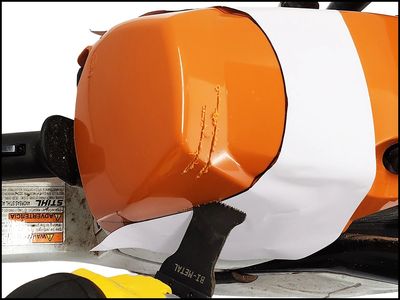
"The Final Cut" is the process of modifying the factory cylinder shroud to allow an external cover.